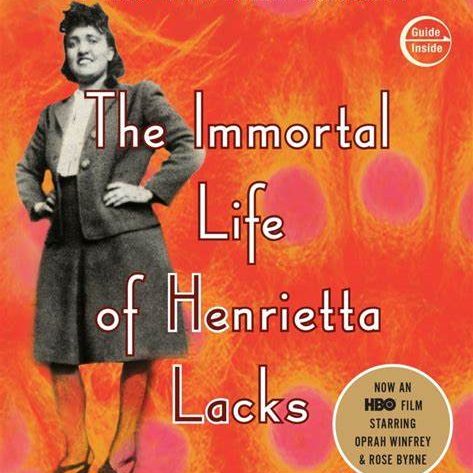
Grab a Copy
In one of the most profoundly beautiful non-fiction books I have ever read, Rebecca Skloot tells the story of the first “immortal” human cells. But this is not just a story of science—it is the story of a remarkable woman whose life was tragically cut short, her cells unknowingly taken and spread across the world for research, and her daughter’s determined search for the truth that had been hidden from her family for decades.
Henrietta Lacks was a Black woman living in 1950s Baltimore when she was diagnosed with cancer. At just 31 years old, the mother of five lost her battle quickly due to the aggressive nature of her illness. Without her knowledge, a sample of her tumor was taken and sent for study. Scientists soon discovered that her cells had the unprecedented ability to survive and multiply indefinitely—something virtually unheard of at the time. These cells, later labeled as “HeLa,” were copied and distributed to researchers worldwide. They played a vital role in groundbreaking medical advancements, from developing the polio vaccine to studying the effects of nuclear radiation and even space travel.
One might assume that someone who made such a significant contribution to medicine would be widely recognized. However, Henrietta’s name remained largely unknown, even to her own family. Scientists anonymized her identity, referring to her only as “HeLa,” and the Lacks family only discovered the truth long after her passing. Her story is a poignant example of how prevalent racism was in 20th-century medicine—even as Skloot was writing the book, the Lacks family had received no real recognition and had little to no access to healthcare, despite how prevalently her cells were used in the research that contributed to much of modern medicine. Similarly, her cells were taken without her consent, which was a practice that unfortunately happened to individuals from the Black community at an alarming rate. It is because of the medical horrors she unknowingly faced that I believe she is an important figure to highlight during Black History Month this year, especially locally, as this story took place here in Maryland.
This book is not just about the cells; it is about the people behind them. Skloot delves into the history of the Lacks family, particularly focusing on Henrietta’s children, who grew up without their mother. Among them, her fourth child, Deborah, stands out as the heart and soul of the narrative. Fierce, resilient, and full of life, Deborah was the only surviving Lacks woman of her generation. Her older sister had been institutionalized after a diagnosis of “idiocy” and tragically passed away in a mental institution. Deborah’s journey is a deeply emotional one, as she searches for answers: What happened to her sister? What made her mother’s cells so unique? Why was her family never informed about their mother’s enormous contribution to medical research?
Skloot’s portrayal of Deborah is both vivid and heartfelt. The reader comes to know and love her just as Skloot did, feeling the weight of her determination and heartbreak. The book is as much a scientific exploration as it is a deeply personal, human story of injustice, perseverance, and discovery.
I cannot recommend this book enough. As a Maryland native, I was particularly drawn to the story of this Baltimore family and their decades-long pursuit of the truth. Deborah’s unwavering spirit, humor, and wisdom will make you laugh and cry, sometimes in the same chapter.
Cancer has personally affected my family, and every year, we participate in the Cycle for Survival to raise funds for cancer research at Memorial Sloan Kettering. If you are interested in contributing to cancer research, you can do so [here] *donations made between Feb 4-6, 2025, will be matched. Additionally, before publishing the book, Skloot established the Henrietta Lacks Foundation, which supports Henrietta’s descendants and others affected by unethical medical research. You can learn more about the foundation [here].
This disease has touched so many lives across the world, and thanks to Henrietta and her immortal cells, we are one step closer every day to finding a cure.









Leave a Reply